Showing posts with label National. Show all posts

29 Feb 2012

Why India must work on its Foreign Policy

Given the status that India currently enjoys in the diplomatic world, it is only natural that India be required to make tough decisions.
The diplomatic power of a country can be analysed by simply taking together factors that act for and against the state at the international level and the state's ability to work out a plan to balance out the negatives that it may face. United States can be considered to be a country that is more or less able to balance out the negatives at the international level (recent 'stand-off' with Russia and China on the Syria and Iran issue can be considered to be a negative that it hasn't balanced out in the UN). 

If we look at India under the same lens, then a couple of inconsistencies do crop up which are common in countries which are still developing their diplomatic power (i.e focus more on the soft power). One of the major  problems that the current foreign policy of India has is the inability to move out of the neutrality sphere. 

After the end of the Cold War, the diplomatic world underwent a period of 'secondary power vacuum' wherein, the west was able to take major decisions without being challenged in a manner that would threaten its dominance in the diplomatic world. Yet soon countries like Russia, China and India caught up and three together are no able to form a major opposition to the west at the international level.

Thus while the three are able to form a formidable opposition, India's foreign policy still hasn't evolved enough to take a stand with one side and through out the course of the event remain on the same side. One of the major example of this would be the recent decision by the Indian government to send a diplomat to attend the Friends of Syria meet which is considered to be an anti-Assad and a pro-change forum. This decision has certainly raised a few eyebrows towards the effectiveness of the Indian bureaucracy and government in formulating a foreign policy meant for the long term.

While at the same time, this can be considered to a successful practice by India of its principle-based foreign policy. However such a practice cannot be considered to be an exactly ideal path to follow at the international level and thus a certain reworking of the foreign policy is in order as India tries to analyse the pro-cons of its relationship with various countries in this every changing world.

29 Jan 2012

Democratizing the Nuclear Neighbour

Despite the fears of a coup, India must ensure that conditions are maintained to retain some state of democracy in its nuclear neighbour.

Historically, relations between the Pakistan Army and the Indian government haven't exactly been friendly. Since Independence, they have bordered at extreme paranoia and complete distrust. Attempts to start/maintain peace between the two neighbours has seen the civilian government in Pakistan asking for the "go-ahead" from the Army. In case the above hasn't been done, the efforts to achieve peace have been scuttled at the very basic stage.

Thus, it is not in India's interest to allow the Pakistani Army into power. But any attempt to do so by using "unacceptable" methods would only ensure that the public opinion tilts in favour of the Army (something that has for the last couple of years prevented the army from coming to power). A more intelligent approach would involve encouraging the civilian institutions in Pakistan to maintain their grip on power mainly by covering them in the mainstream Indian and international news media. 

Also covert funding to moderate pressure groups in Pakistan would be an ideal path that the RAW (India's spy agency) can take in order to ensure that the public opinion remains in favour of the civilian institutions while at the same time ensuring that a balance is attained with the extremists. A situation resembling the current Indian state of affairs (extremely active civil society) would provide democracy the much needed boost that it requires in the country which has a history of democracies being overthrown by military coups.

For India, a military government is not acceptable considering the fact that all the wars that India has fought against Pakistan happened during the military rule. Thus any attempt to install an army government in Pakistan can only succeed if the 'terror of India' is created in the minds of the Pakistani people. The paranoia regarding India has always been the stepping stone that the Pakistan Army has needed to hoist itself to a position of direct power (indirect power involves tremendous amount of influence on the civilian government while refraining to portray itself as a major political power in the public eyes).

A face off with the US (though highly unlikely) would certainly create the buzz that the Pakistani Army needs while at the same time uncomfortable relations with India would certainly put the civilian government in an uncomfortable position. Thus attempts to improve ties between India and Pakistan should be on the top of the priority list for Pakistan.

Closer trade ties involve direct interaction between the people and thus the mistrust on either side is reduced every day little by little. It is only through such attempts of improving ties while at the same time not 'bowing down' with/to other countries in the public eye can the current government in power hold on to its present position and last till the next elections where the verdict might or might not go against them.

On the other side of the globe, it would be ideal if USA took steps so as to improve the ties with the current government in Pakistan at least till the elections are over. A civilian government in power is the only way the USA can attempt to get rid of the Taliban and terrorism which has time and again proved to be a strategic asset for Pakistan against its rivals in the Indian subcontinent.

4 Dec 2011

Why India needs to intervene

Despite the anger in Pakistan regarding the NATO strike, it would be a wise decision for India to play the peacemaker between Pakistan and USA.

With the emotions of the populace boiling up, it is rare to see the leaders of a country take the right decision instead of the popular one. The leaders in Pakistan are faced with the same puzzle at the moment. With anger against the NATO and the USA rising, it would be wise for the Pakistani leadership to look at their present situation in a whole some manner and not overlook one aspect just because the pressure on the other aspect to be viewed is greater.

All the warnings, talks and decisions that are being given/taken by the civilian government/army in Pakistan would have tremendous consequences not only for Pakistan but also for the region as a whole. The US-Pakistani relationship has had a lot of bumps ever since the Abottabad raid but since then, this can be said to be the single worst incident in the relations of the two country. 

US presence in Pakistan and Afghanistan is essential for India's national security and also the security of the Indian interests is heavily dependent on the US presence there fore the time being at least, as India starts to play a greater role in Afghanistan and have a greater say in matters. Thus, the removal of the US boots from Pakistan would be a major blow to India and its interests. With the vacating of the Shamsi Airbase (if that happens), the entire incident would be a major strategic victory for the Taliban, which has many sympathizers in the Pakistan Army, which is making attempts to come back to power in Afghanistan.

India would now require to act in order to protect its interests. First of all, the Indian administration must ensure that Pakistan gets the message that India sympathizes with them and then slowly and steadily work would need to be done to ensure that the US do not vacate the Shamsi Airbase. Many in Pakistan have already viewed this 'accidental' attack as a direct attack by USA and India on their sovereignty, which has already been an issue of contention between the once upon a time allies (USA and Pakistan) for quite some time. Any more fuel into this fire would only result in consequences for the entire region including China, who want the US to exit from the region in order for them to achieve a greater level of influence on the struggling Afghan civilian government.

With the exit of the US troops from the region it would be very easy for the Taliban to take back control of the areas near the North-Western border of Pakistan and Afghanistan, which has very limited government presence with majority of the area being tribal in nature guaranteeing a firm base for the Taliban to make a comeback into the region and the regional politics.

India would need to bring the two allies to the table and ensure that both of them engage in a healthy discussion and sort out their differences at the earliest, if India wants to ensure a peaceful and stable neighbourhood. Manmohan Singh could play a major role in bringing the two to the table using the respect and influence that he has earned in the government circles of the both, the US and Pakistan.

Till then it can be expected that with the pressure on the government and the army in Pakistan building up to take a strict action against the US, the relations between the two allies can only expected to go downhill, if there is one. The US would need to play calmly at the moment in order to prevent the situation from worsening. But it sure isn't going to be a easy journey to keep track of unless and until India does not intervene.

19 Nov 2011

Walking the Pakistani Tightrope

Even though relations between the two rivals are normalizing. It is in vast contrast to what lays underneath the surface.
The move by Pakistan to grant India the MFN (Most Favoured Nation) status was welcomed by a big majority in the diplomatic circles and was hailed as move towards a shift in the relationship between the two nuclear states. Manmohan Singh and Yousuf Raza Gilani who met in Maldives recently decided to break the deadlock that the two countries were in since after 26/11. Yet there continue to be rumors that there is a lot more than meets the eyes.

The UPA government which is at the moment at its lowest ever in public popularity is doings its desperate best in an attempt save face. With allegations against members of India Against Corruption rising, the government at the moment remains fairly convinced that it might have a chance in the state elections that are coming up in the next two years leading up to the general election in 2014. But even as the elections at the state level happen, there is a lot of reason for the UPA to take care in the way it deals with issues like terrorism, nowadays a major vote-puller in India.

Though the number of attacks in the country have decreased a lot, there still continues to exist a state of uncertainty among the populace as they deal with a neighbour (Pakistan) which every day heads close to either a military coup or take over by Islamic fundamentalists. The anger in India continues to be at the same level as after 26/11 with many a facebook pages coming up with negative results regarding celebrating the return to normal relations between India and Pakistan. Youth in India is eyeing every development with a keen eye, ready to get out on the street and corner the government for any mistake that they make. Hence, the ability of the UPA government to deal effectively with Pakistan will determine their odd of winning the upcoming elections. 

Carefully keeping the 'Kashmir' issue off the table, the government has succeeded in brushing of concerns of an 'unfavorable' round of table talks. With an on-going dispute between Omar Abdullah, the Jammu Kashmir Chief Minister, and the army already heating up the atmosphere in the country, including the Kashmir issue would have been a certain death warrant for the present Government. But the step to not include talks on punishment of the terrorist is also a bold step for this government which faces continuous flak from BJP, the primary opposition party,  for any and every mistake that it is committing in recent times.

Hence any progress between the two countries at best is balanced on a thin line at the moment. With internal pressure mounting on the UPA government to prove it's worth, the Pakistan card might just be the trump card that the government desperately needs at the moment. If India is successful in getting Pakistan to hand or even punish the culprits of the 26/11 attack, then it will be a guarantee that the odds against the Congress for the 2014 general election would have been countered and all parties would be on the same starting point.

Thus even as India tries to do its best to reach out to Pakistan, India's friendliness would directly depend on what Pakistan is able to do against terrorism. Any further attack on Indian soil would not only damage but paralyze the relationship for a long time if not permanently. Thus the onus is now on Pakistan to show results as the UPA government puts everything on line for their Pakistan card.

30 Oct 2011

Right to Recall: Step towards better governance or disorder?

Recently media's favourite Gandhi topi boy started off a discussion on electoral reforms. Yes I am talking about Mr. Anna Hazare who has enjoyed a lot more than the supposed 'fair-share' of the lime-light. He has talked about getting rid off corruption and also Congress to put it frankly. But now he has taken up the topic of electoral reforms. This topic as good as it may sound does not quite ring a bell with many people. There have been many attempts through out history to make elections better and fairer but most of them have failed and there are many reasons that can be attributed to this failure. But none of them would have managed to influence these reforms so much so that they end up being failures, unless and until they did not have people behind them.

Electoral Reforms basically aim at ensuring that the people get their 'money's worth'. Some of the electoral reforms that Mr. Hazare has been so overwhelmingly talking about are The Right to Recall and The Right to Reject. These rights have been tried out by many nations and in most of the cases, there has been a gross misuse of them. But why does it so happen? The reason is fairly simple to decipher. A democratic country functions on the simple concept of people choosing their representatives and ensuring that they work for them. My statement is ensured by elections which happen both for the purpose of electing representatives and also for throwing them out. History has repeatedly proven my latter statement to be true.

Governments have repeatedly fallen and so have representatives for the simple reason that their policies failed to bring about the result desired by the electorate. And that is how a democracy should and must function. So then what is Mr. Hazare trying to say by bringing up these issues of Right to Recall and Right to Reject. According to him, he would like the electorate to enjoy the option of having a Right to Recall. What is Right to Recall? Right to Recall is a constitutional right that can be given to citizens of an electorate so as to recall their representative and hold a new election to elect a new representative. In short it is basically removing a representative from office before the regular elections and then holding an election to get a new representative.

It is done by holding a signature campaign/election of sorts where in if around 30% (number varies, it is 5% in some countries) of the people sign the campaign to recall the minister than a new election is held and in this new election, the people have the option of either continuing with the present minister or voting for someone new. Thus in short it is a long and tiresome process and not to leave out the expenses part of it. A process like this though is called the epitome of democracy is meant for developed countries with adequate funds to spare and an electorate which is educated in political matters and thus not influenced a lot by ideological leanings, religion, place etc.

Electoral exercises like these should only be seen as a very distant dream in a country like ours for the simple reason that we haven't reduced poverty to below 5%. It is amusing to see people talk about this exercise with such fervor while at the same time it is this group of people who strong arm the government on issues of inflation, which is affecting the poor sections of society terribly, and poverty which according to them is simple an example of the government failing to do what it was meant to do.

Hence with so many problems like inflation and poverty already in front of us, it would only be a Koalemos' dream to have such a huge project implemented in India without even understanding and taking care of various other problems like poverty and a politically illiterate majority. Thus this is nothing but a desire to ape the west (a term that I am personally against) without taking an appropriate look at the real situations that affect the electorate in their daily routine.

16 Oct 2011

The Indian and International politics on Anna Hazare

NOTE: This article was written on 9th September 2011. Thus some facts might not be correct. Any error is deeply regretted.

News channels do not seem to be tired of airing virtually the same content everyday. Every channel that you switch to, there are discussions by expert panellists on the future of JanLokpal and whether Mr. Hazare should be ending his fast. There seems to be a unanimous response for the latter with almost everybody saying that Mr. Hazare should end his fast. Some people rather critical of Mr. Hazare pass comments on how it is unconstitutional, which it is, while the others urge him to end it as the idea behind the fast has been accomplished.

What was the idea behind the fast and all that followed? The real idea behind the entire event seems to now be lost in the cacophony of theories of government conspiracies against the 'civil society', opinions on how this entire event is now turning into an anarchist display of anti-corruption façade and proposals of alternative bills. The people at the moment seem to be disconnected with the real idea. They have caught onto a definition of the event which is a work of minds angry at the lack of government action on issues of corruption, terrorism and other events.

Individuals are singing vande-mataram slogans at the moment while allowing themselves to be intoxicated by the talk of this being the second freedom struggle, which it certainly isn't. This struggle which started off as a journey by a single individual, Mr. Hazare, against the government's inaction on corruption now seems to have acquired definitions and thoughts which are miles away from any initiative to get the country rid of corruption and other such malpractices generally thought to be performed by public servants.

Yes, this entire event had been sparked by the anger of one person over the ever increasing corruption that India seems itself to be surrounded with. The individual in question, Mr. Hazare, went on a fast and it soon garnered public attention. What I feel is that where public is there, it is imperative that news channels be there for that is the only way that they will be able to establish a connection with the wider society. Thus media crews descended upon the site and soon there were high-TRP shows on every news channel that was on air.

As the coverage increased more and more people flocked to the place and to their television sets. Soon the government found itself in the midst of a storm and they tried their best to fight it. Arrangements and settlements had to be made and thus the government and the civil society came to an understanding and the movement for the time being ceased. A Drafting Committee was formed to look into the matter. However, there was no further concrete action by the government on the issue which resulted in Mr. Hazare once again threatening to go on a fast on the 16th of August this year if the bill wasn't passed till then.

In the meanwhile, Baba Ramdev also went on a hunger strike. He demanded that all the black money that was stashed abroad in tax havens by Indian citizens be brought back. Followers gathered at Ramlila Maidan, the location of his agitation. The crowd grew. Kapil Sibal, a cabinet minister, asked him to stop the agitation. However, Ramdev continued on and even hardened his stance. Till now, tremendous public awareness had been generated on the issue and even the youth started taking to their various forms of protesting be it online or forming groups and marching. 

Around midnight the Delhi Police entered the place and resorted to 'lathi' charge to disperse the mob. The government came under fire and the common man took the stage. There were mass-rallies against the government and it was said that the government was being autocratic, a charge which I find ridiculous when we look at the real situation.

The real situation was that, had the police not started the crackdown at Ramlila Maidan than in the morning the place would have been an anarchist's heaven for people gathered and aggressively pitched their anti-government stand. The very basic right to freedom of expression was being manipulated over here to suit the  anti-government supporters. There was simply no sense of sensibility in the people that night at Ramlila Maidan to put it frankly. 

Mr. Hazare was arrested on 16th August just before he was about to commence his fast. Neither the opposition party and nor his supporters took kindly to this decision and there were wide spread protests across the country and at places, people voluntarily courted arrest. Under heavy pressure the government released him. 

The protests continued and so did Mr. Hazare's hunger strike. The government and the civil society tried to negotiate over the text and other provisions of the bill but there were repeated break-downs in talks and later on the parliament passed a resolution agreeing to the demands of Mr. Hazare and decided to  reffer the matter to a standing committee. 

INDIA

I am disappointed looking at the manner in which the citizens of India have responded to this entire event. As per a survey done by a newspaper, only 2 out of 5 JanLokpal supporters were actually even aware of what the bill proposed. This apathy towards political institutions, be it the government or 'civil society' is saddening. Individuals came out with the national flags. Waving it as if with every thrust of it, they were proving their  patriotism which existed in their hearts for the country.

How is a person waving the national flag going to stop corruption in its track is a phenomena that is beyond the understanding of my rather practical mind. Yet the supporters of this media hyped campaign claimed that it was changing the mindset of the people. Sure it was, but how was it really going to manifest itself in the daily day to day happenings in the lives of these individuals?

While having my morning breakfast one day, my grandma raised an interesting point. She said that if everybody (almost the entire country as claimed by Mr. Hazare and Co.) in this campaign was not corrupt then, who was corrupt? It was quite interesting to note this point which I had seemed to have overlooked. Even as I pondered on this topic, I couldn't help but think about the real situation that was unfolding.

Groups of people were surrounding the houses of MPs (Members of Parliament) demanding that this bill be passed, without as much as even a proper discussion. This group consisted of people, half of whom I wouldn't like to see near my house. They were the simple common youth who had been simply brainwashed into believing that Mr. Hazare was the only individual against corruption and that the political and elite class would not be benefited if this bill were to pass. Thus the 'struggle of the common man', as the news channels had suggested, continued with a fierce boost.

According to me, these groups that were forming chains and surrounding the houses of the MPs were resorting to harassment. Had I been a MP then I would have gotten appropriate action taken against all of them because that is not the way of asking something from your elected representative. The individual is a representative and not a servant of the people. If people need to demand something from him, they should go through the appropriate mechanism of doing that. It would involve first taking an appointment with the representative and then addressing the issue at the appointment that you wish to make your representative aware of. At a point of time, there were even calls to surround the house of the Prime Minister. The Prime Minister? He is the most important person in the country. Terrorists could have easily taken advantage of such a situation and then assassinated him. What would the consequences have been? They would have been severe. Curfews and complete police control over activities.

Although such a thing did not happen while the government tried to unsuccessfully stop the protesters from surrounding the house of the PM by stopping the metro train services in nearby areas and by cordoning off the area. I think that there is no explanation whatsoever to justify such an activity that was carried on by supporters of Mr. Hazare. Common sense and normal practice says that these picketers should have been arrested on ground of disturbing peace and acting as a threat to the PMs security and should have been dealt with accordingly.

As these events were unfolding it was very much evident that the common man had simply lost his ability of reasoning and the anger over the government poor handling of situations involving corruption and terrorism was flowing down the pot and was acting as a boost to the already racing adrenalin. These situations arise very often in democracies and need to be dealt with in a manner that is neither harsh nor soft but sets a tone for the proceedings.

Thus even though Mr. Hazare like a true gentleman said that all the proceedings should happen in a non-violent manner, it is difficult to ensure that people's excitement won't get the better of them and that they won't turn violent. It needs to be noted that very many of these non-violent protests end up becoming violent when a single individual loses his control and attempts to act as the legal guardian of the law through ways that are not legal and a clear violation of the provisions of the constitution.

Hence, the lesson that the political class and the people should get from this entire event should be that of being legal in whatever they do. Of course many from the political class can find loopholes in the current slightly outdated legal structure but what they must keep in mind is that though they may get away for the time being without being caught but a time may come when they may find themselves in a corner and the anger of the people flowing towards them like molten lava. Thus, the political class must take the responsibility of acting in a manner that is clean and fair towards the country. There should be zero tolerance for unfair advantage which the politicians use to create a better lifestyle for themselves.

While at the same time, the people should also not be allowed to get away with any and every practice that they may follow. What they should do should be within the legal framework of the constitution and the UN Charter on Human Rights and should not be a manipulation of the duo. The people are the most important element of the state and thus it is essential that they follow the correct path for if they as much as even get slightly distracted from the correct path then there will be chaos, pandemonium and anarchy. The people cannot take everything into their hands. They need to utilise the correct provisions, procedures and mechanisms as provided to them by the legal bodies for the overall good.

PAKISTAN


Pakistan is an example of the path that one country should not head for. However, it is not in the hands of individuals to stop or change the direction of the route that they have taken. They can only manipulate it to either suit themselves (example Mr. Gaddafi's earlier practice used for suppressing rebellions, now rather unsuccessful) or the country. Pakistan has been in a state of chaos for a long time now. Every other day individuals opposed to the stringent laws that are established by a certain religion are killed, journalists investigating into the frauds of the government suffer the same fate and the people there are scared to openly criticize the government or the extremists. It's basically a no man's land.

However, there is no authority that can take over and try to control the situation and ease the stress. Here is where the Indian connection comes in. The country though has a human rights body but it is more or less like a body set up to ensure that the provisions of the constitution are maintained. Though it has no authority over the happening of the country and due to the extremist state of affairs that is prevalent in the country, there is a lot of fear.

Here, now a powerful body, something like what Mr. Hazare is proposing can be brought in. But what needs to be taken care of is that this body should be primarily for the Human Rights of the citizens as an all powerful body like the JanLokpal (as proposed by Mr. Hazare) can become autocratic in its functioning. Thus over here only the police force should be under this department and there should be no political interference in the matters it deals with. However to ensure that it does not become autocratic in nature, provisions, mechanisms and many loopholes would need to be worked on.

Such a body can easily function in matters related to Human Rights in Pakistan and once the people are not afraid then it is the government that would be afraid. In India due to the vast presence of Human Rights activists, the governments are scared to take steps which may be deemed as anti-human rights and try to avoid them as much as they can. But for a country like India an all powerful body to deal with matters related specifically to corruption would be like inviting a lion for a feast. The lion may enjoy the feast and become your best friend or you may become its feast with the chances of the latter being higher.

CHINA


China can be best described as a country that is still waiting for a spark. Thus it is no surprise that the party is trying to do everything that it can to improve its image that has taken a beating after the train accident which took place recently. Though however much the party tries to come across as a non-corrupt set up whose sole purpose is the betterment of human life in China. It is exactly the opposite that most people believe.

People in China have since long identified the party as corrupt at the grass root level. Senior leader in the party are thought off as non-corrupt and honest individuals but yet it is the grass root politics everywhere which influences the people. No revolution takes place because the country as a whole is doing bad but because every region as a whole is doing bad and a similar situation though however much exaggerated it may be by the Chinese critics is slowly but steadily developing in China.

People have started questioning the motives behind the party's continuous attempts to remain in power. Though the party may try to come across as working for the people but the question is that how long will the people be contend with this face that the party is showing. Soon there will be protests. Its a matter of time that some incident takes place and the entire country erupts. In this modern age of the internet, it is difficult to segregate a group of people by simply cutting off the internet connect and this is fairly evident from the situation that we can see in Libya.

However, what can the party do to improve its image? One of the suggestions that people give is set up an anti-corruption body with ultimate power but every where it is the same issue that ensures that talks fail. That issue is of the amount of power that can be allotted to this body. No government in its right mind would be favorable to giving unlimited power to such a body for the simple reason that the power of the government might become weak in front of it.

While at the same time, it is said that China has been funding these events that have been happening in India. However, there has been no proof of this theory yet it is a theory that dominates the discussions of the conspiracy theorists. If it were to be true, then though there won't be any major effects on the relationship that the two countries, India and China share but this will certainly act as a thorn.

India may not directly take any action against the Chinese for this reason but behind the doors a lot of action may happen such as India providing excess funding to groups hell bent on creating troubles for the party in China. However this is a very remote possibility since any such action by the Indians would have direct repercussions due to China's growing assertiveness.

Thus the Indians may just stop supporting China all the time on issues in the international sphere and may take positions at times which may not please the Chinese. Hence all in all this is a very complicated issue which for all one knows may not at all result in anything and might just end up being ignored by the Indian Government which is ever ready to promote peace and stability in the region.

USA


USA is considered to be the most successful democracies of all time and it is true. And hence it is only justifiable that the US would do things to help the democratic setup in other countries and we can see that it is doing work in Afghanistan and ensuring that the new Afghan set up continues to get the much needed oxygen. However there have been allegations by some members of the Indian National Congress (party in power) that the USA was indirectly funding the Anna Hazare movement.


So serious were the implications of this statement that the US came out with an official statement that it in no way was supporting Mr. Hazare. It is true that at the moment, the US cannot afford to have its ties with India strained, especially at a time when most of the middle-east takes an unfavorable view of the US, India is the only friend that the US has who has the ability to influence policy-makers in the middle-east.


Apart from that, Indian co-operation is something that India would soon need desperately in the UN and other International bodies as China starts to flex its muscle and counter the US and at the time being, India is the only counter balance that USA has to the mighty dragon. However, there is a major conflict of interests in this regard.


India and China are seen as the face of the developing world and that is a fact. In every major convention or event, the developing countries look up to these two giants for support so that their demands are looked at and seriously considered instead of being dropped and lost in the bureaucracy. And thus it is quite essential from point of the developing world that India and China continue to show the same co-operation that they had shown in Copenhagen.


While from the US point of view, it is essential that the US try to get India to tilt even if by just a few degrees to its side if it is to maintain its position in Asia and the Pacific.


Thus all in all, so great was the Anna Hazare episode that it promoted almost all the countries which share a special relation with India to respond or to act in a particular manner. Only time will tell how the world economy and the politics take shape as more and more countries slip into the euphoria of the Jasmine Revolution and demand greater freedoms.

25 Jul 2011

Violence Is Not Preached In Religion


Few days ago a politician wrote an article trying to analyse and finding a solution for Islamic Terrorism and it was published by a reputed newspaper which now I feel has lost that reputation at least in my eyes for the simple reason that even though people get angry at various situations and don't know what to do except just blame others but they engage in self-control and self-censorship for the fear that what they do might have repercussions in the future, for their country, for their kids or for people in general and that is what is humane. However neither this 'reputed' newspaper and nor this politician seem to be on the same page of the dictionary.

      It’s been happening ever since the twin tower attacks. Since then people have been linking a particular religion as a synonym of terrorism. This way of thinking is not at all rational. Recently Norway had its share of terrorism when a fundamentalist Christian bombed a building and massacred people with his gun in cold blood. I would like to know what this esteemed politician would want to say to that or what would he say when he is asked about the nuns in Odisha who were raped by people who supported their 'saffron' leaders. What would he say about those Sikhs who were killed by the mob just after Indira Gandhi was assassinated? There are no limits to the number of examples that I can give of barbarism that has been committed by people of nearly all religions. 

      Even Ashoka the king attacked and killed people but then he learnt of his folly. He looked in the eyes of the mothers whose sons he had killed, he looked at small children who played unaware that their father was being taken for cremation and how would a wife feel when she is to know that the man she loved for years has been killed in this fight for land. These question are relevant even today, it is only the reason behind this new 'war' that has changed everything else remains the same. Even now kids would be made orphaned; even now parents would just look on as the child who played on their laps is laid to rest before them. Earlier people fought over land and today they fight over god.

      It is strange how people think that only their religion is right and that it their birth right to ensure that others bow down to their way of thinking and follow their religion. Not many thankfully think like that. However there are elements whose ultimate objective is to simply kill of the opposition or ensure that they convert to their form of thinking. That is exactly what that article of this politician hinted at. 

      The sad part of this form of democracy in India is that, even thought people may fight for their rights and talk about more freedom and protest if the state as much as tries to clamp down on even a single right of theirs, the people in India are simply not ready for this form of multi-party democracy. And they won't be until and unless they stop voting on the basis of religion, caste, gender, region etc. This has to stop. How is a country to progress if the people themselves are divided on the basis of these small thing which at the end of the day won't even play a minor role in shaping my future?

      Everybody talks of progress and growth but when will the people themselves grow up and look at each other as humans and not as individuals from a different religion. Humans are supposed to evolve into intelligent life-forms. They are meant to make miracles happen. And miracles do not happen unless one does not think beyond himself/herself. They only happen when an entire community is to be benefited; for even if there is a god, he won't want only one of his kids to have his wish full-filled. He would want the wishes of the entire community's be full-filled. That child who was about to die of a disease survive thanks to a transplant. As the sun is about to set on his life when he is in his seventies, that same kid in him would ignite and he would look around him and ask, how has my existence helped those around me? And as he says this his eyes will first go to the picture of a dog whom he saved from coming under a car. He would look at his family and see that they are crying and he would know that in his life, he has done thing, good thing, for the grave of a bad man does not get any visitors, as Mr. Scrooge had dreamed.

      Thus similarly it is true that whatever religion you may follow you want to end up in heaven. And the gates to heaven do not open for people who have done bad things in their life.  A mother in a movie explains to her son when the son unknowingly talks about killing people of another religion, she says "There are two kinds of people in this world. One who do bad things and the other who do good things. It is up to you who you want to be." This line is absolutely true in life. I for one can never ever even think of killing another human let alone do it for ethnic cleansing. Its the way I have been brought up. My mother used to tell me the same thing that they said in the movie. I have decided who I want to be life. Now it is your chance to decide.

17 Jul 2011

The Time After The Blast

A couple of days ago, a tragedy struck us. Three blasts rocked Mumbai and with it also the country. Nothing could be done about it. News channels aired their favourite 'Are you safe?' programs while papers came up with ridiculous headlines which instead of showing sympathy and support to the victims commercialised their agony. Ministers claimed that it wasn't a failure of intelligence, some questioned that claim while the others simple said that during their rule the number of such incidences were limited and advocated a zero tolerance policy for Terrorism. It didn't bother me what people had to say about the incident. What bothered me was what they did about it and how they helped the people in need.

      I am very happy to say that I wasn't disappointed as the human spirit awoke as the news about the blast spread and people offered their help to the stranded. Social networking sites were full of offers to people to give them a ride home, offering a place to stay and people even from the overseas tweeted to the stranded telling them that they would call the folks of the stranded due to the mobile network being down and all. Nothing more could have been done to show how united the people were. The terrorists only succeeded in revoking those sentiments of unity and sympathy which were not seen on the faces of news anchors as they went into commercial break after having had a chat with their correspondents on the death toll.

      The topic #mumbaiblasts became a worldwide trending topic on Twitter for a couple of hours while tags such as #offer2help came up as people tagged their offers of help and sent around a message to the masses. Some of the stranded responded to the tweets and they were taken care of. People took out their cars and drove up long distances only to help a person stranded at a temple reach home. This simple act of kindness gave me an absolutely strange feeling as I looked on in delight as offers to help flowed.

      The common Indian politics started soon after with many a people blaming certain communities for the tragedy that struck us all. This one thing infuriated me the most and I lashed out at those who were trying to incite communal hatred. Of course they had their own reasons which they childishly tried to prove right in front of us as me and a couple of my friends questioned the very logic behind each of them and proved them wrong. Many a friends of mine on Twitter asked me to not respond to them but then I couldn't help it and gave the irritants a piece of my mind. However trolling continued.

Source
      Even as the twitterati offered help, news channels went from celebrity to celebrity asking for their opinion on the blast. That according to me was very immature as no person with a rational mind set would support blasts aimed at civilians and true to rationality all condemned the blasts and offered their condolences and sympathy. One thing that did strike me was that the very next day, the city came to a halt quite to the delight of the terrorists whose aim of bringing the city to a stop had been fulfilled. Roads remained empty and offices, schools and colleges recorded the lowest attendance ever. However I did go to college.

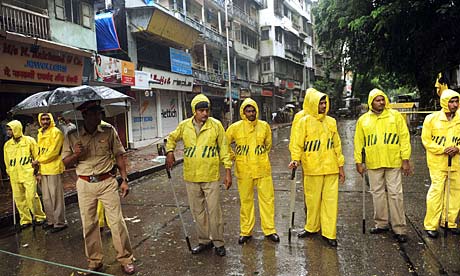
      Even as I entered the college there was an eerie feeling. Two souls looked at me as I showed the watchmen my ID and entered the campus. The basketball court was deserted quite unlike normal days when it has people playing and at times talking to each other in groups. Rain poured down as I traced my steps to my lecture room. It seemed like silence had indeed invaded the place. A teacher replied, when asked why the college hadn't declared a holiday stating that the Principal thought that by declaring a holiday they would only be ensuring that the terrorists get what they want i.e. the ability to bring fear into our minds. I sat in my class and talked to five students out of a class of hundred who were present. Only one lecture took place that day.

      What my principle said was indeed true. These acts of bombings had always been meant to bring fear into the minds of the people. Even as leaders visited the victims and talked policy, the roads remained empty. The crows circled the sky as cops wearing raincoats stood at various points eyeing each and everyone who passed them. The terrorists would be caught shortly but what would happen? They would be given a 'free and fair' trial and then they would stay in prison courtesy the Government of India. Next day the city returned to normal as cars honked at each other and students responded with a 'present' to the attendance call. Nothing should ever break this spirit of our again like the way it was broken on that day for till we are here we must refuse to bow our heads to terrorism.

29 May 2011

Psychology of Views and Decisions

      What is the routine that you wake up every morning to follow? I bet it involves reading the newspapers. Sure it does. What are you nodding your head for? OK? So you open the papers and what is the first news that you read? Killings, rape and violence. In simpler words it is all the things that the world would be better without and also that you would be better without every morning. After all it is much better to wake up every morning to read happier things. But do the papers realise that? I don't think so.

Source
      Regularly they feature events that are not so pleasant to either the eye or the emotions on the front page and we like the silent people read them, go through them and the worse it is the better. At times it seems like we have been taken over by a sinister evil that wishes to see all the gory details so brilliantly highlighted in the newspapers. We do not have any control over it.

      But how did it grow so big in the first place that even our superior organs like the brain can't overcome him? Well it is simple now that you ask. It has grown. All the rubbish that we fed it acted like nutrients for it and it bloomed. There are few things in this world and life that we can do.

      And it is these things that we do that define us. Also there are those things that we don't do that define us. As such we are surrounded by options, options good or bad. However what we need to look at is: what is it that we have done and or will do and what would their consequences be? Can they be put into the 'good' circle or the 'bad' circle.

      Whatever we do may not have its effects immediately but it will in the future, you can be sure about that. Thus every time we do something or decide to do something just give it a second's thought and view all the paradigms attached to it. That is all you need to do to lead a good life. Once you have analysed everything, you will choose the right option automatically.

15 Jun 2010

The Complicated Indo-Sino Relationship Part III

India and China are two giants located in South East Asia. These two giants exercise a lot of power over Asia. They have had conflicting views but they have formed an alliance of sorts against the developed countries which want to impose their policies on the developing countries.

There are many issues which unite the two countries together. One of them is terrorism. Terrorism has targeted both the countries. Terrorists are pretty active in China which has resulted in the Chinese forming many policies. In the future also the fight against terrorism may continue and it will unite more and more countires together.

Energy is going to be a major problem in the future. This will lead to India and China collaborating in the field of energy and coming up with new technology. I have made this assumption based on the fact the two countires produce excellent scientists.

Diplomacy is a major issue which is going to affect world policy in the near future, or should I say that it has already started affecting it. India and China will come together to form a major front for the developing countries. This front will be extremely powerful as it would also involve countries like Brazil. This front will start wresting power from the developed countries and soon the world policies will favour the developing countries.

There many things that will  happen in the future. This topic of mine just dealt with some of these things that will be affecting India and China. I will soon start a parallel series that will deal about things that will happen in the future and that series will include countries and the state of technology.

11 Jun 2010

The Complicated Indo-Sino Relationship Part I

India and China are the most important nations of the 21st century. They are the rising superpowers. But both have their own respective problems that pull them down. Both these nations will have a powerful say in the world affairs sooner than later. It is already happening. The recent Copenhagen Summit where India helped China in getting a good and fair deal. Such incidents are increasing, where both these nations have taken surprising steps sometimes supporting each other and sometimes against each other. This is what makes the Indo-Sino Relationship so complicated.

Both these countries have a history. There is a lot of mistrust between the two countries which is evident from the fact that they don't trust each other and always view each other with suspicion. This all started due to the 1961 war, when India and China were at war with each other. There are many versions as to why the war was fought but somewhere down the line it is clearly visible that these two nations are a little vary while dealing with each other which has resulted in centuries of mistrust. But why so?

The main reason for all this lies in economics and foreign affairs. Both these countries are going to be superpowers sooner than later and like all the countries in the world, they also would have some differences in opinions regarding various matters. This is quite the case here. Both these countries have huge differences in opinion. Lets take Pakistan for example, China is considered to be an ally of Pakistan which is quite true. China has always supported Pakistan in many of its "misadventures" be it the nuclear weapons race or preventing sanctions. India on the other hand is considered to be an arch-rival of Pakistan. This assumption is mainly based on India's stand on various issues which are sometimes against Pakistan but India has also supported Pakistan, but that is a different story all together. The fact is  that this varied opinion is a major problem in improving the relation between the two nations(India and China).

Another factor is the race. The race for  supremacy which I believe is very much the main problem. Both these countries want to outdo each other in every field. India wants a UNSC seat which I believe is very much India's right because India does not have a big brother(like China for Pakistan and USA for Israel) with a UNSC and besides it has earned. India is the most powerful country in the Indian subcontinent. This is a major problem for China because as long as China has a hold on that seat it will be a big brother type figure in Asia but with another asian country also getting that seat, the big brother image is bound to take a beating and so will its influence.

But this was all about the negatives shared by the two countries. Positives are also there. Both these countries have realised that though they may be powerful nation but it is still not enough to overcome the US supremacy. This resulted in the two forming an alliance of sorts at the Copenhagen to get the result that they both wanted. This played the trick. India and China are so powerful nations that when together even the US can't impose its policies and ideals on them. The duo agree on many matters like terrorism. But this is still not enough. A lot more should be done to improve the relations.

India recently gifted a replica of Sanchi Stupa to China. Such acts are the most welcomes as they help in improving relations between the two countries. This improvement in relations might lead to a new era of diplomacy wherein both India and China to help and support each other in their own various endeavours. The time has come when these two nations will join hands and change the vary face of International Politics.

TO BE CONTINUED....

THIS POSTS CELEBRATES THE IMPROVEMENTS IN THE INDO-CHINESE RELATIONSHIP.